

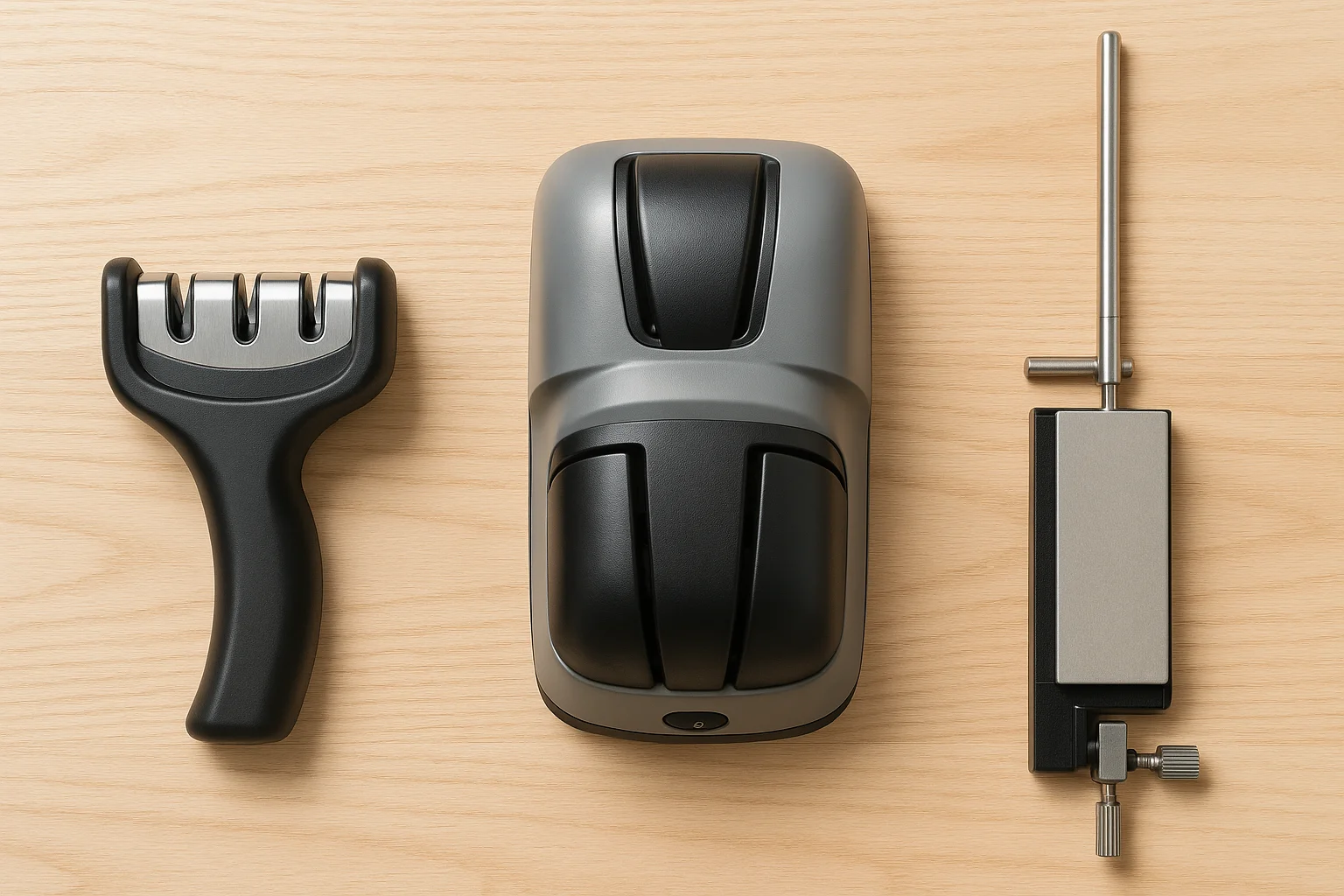
"Knife sharpener" covers a wide range of tools — pull-through slots, motorized electric wheels, and guided manual rod systems — and each one works differently enough that using the wrong technique can do more harm than good. None of them require the years of practice a whetstone does, but each has a right way and a wrong way to use it.
Pull-Through Sharpeners
These handheld tools have one or two V-shaped slots lined with carbide or ceramic abrasive, set at a fixed angle. To use one: hold the sharpener steady on a flat surface, insert the blade into the coarse slot near the heel, and pull the full length of the blade through with light, even pressure — let the tool do the work rather than pressing down hard. Repeat 3–5 times, then move to the fine slot (if it has one) for another 3–5 light pulls to refine the edge.
The main downside is that the fixed angle isn't adjustable, so it may not match the actual angle your knife was originally ground at, and repeated use removes more metal than a stone would for the same result. They're a reasonable choice for a quick touch-up on straight-edge kitchen knives, but not ideal for thin Japanese blades or intricate Damascus patterns, where the coarse carbide can scratch the pattern unevenly.
Electric Sharpeners
Electric sharpeners spin abrasive wheels at a fixed angle inside a guided slot. Turn the unit on, insert the blade at the marked entry point, and draw it through slowly and steadily from heel to tip — don't force it or pause partway, since stopping mid-stroke can create an uneven spot. Most units have a coarse stage for repair and a fine stage for polishing; use the coarse stage only if the edge is actually damaged or very dull, since it removes metal quickly.
Electric sharpeners are the fastest option and give consistent results with minimal skill, which makes them popular for straight-edge Western knives seeing daily kitchen use. They're generally too aggressive for delicate or highly polished edges and won't work at all on serrated blades.
Guided Rod (Clamp) Systems
A guided system clamps the spine of the blade and holds a sharpening rod or stone at a chosen angle via a fixed arm, letting you draw the abrasive across the edge with near-freehand quality but a locked-in angle. Set the clamp per the manufacturer's angle guide, then draw the rod down and across the edge in smooth, controlled strokes, alternating sides evenly. This method takes longer than a pull-through or electric sharpener but gives far more control over the final edge and works well on Damascus and high-end steel without the guesswork of freehand stone work.
Which Type Suits Which Knife
- Everyday Western kitchen knives: pull-through or electric, for speed.
- Damascus and high-carbon blades: guided rod system or a whetstone, to protect the pattern and avoid removing more steel than necessary.
- Japanese-style thin-edge knives: guided system or stone at a lower angle — pull-through slots are usually set too steep for them.
- Serrated knives: none of the above — use a tapered sharpening rod worked into each individual scallop instead.
Mistakes to Avoid
The most common mistake with any sharpener is pressing down hard, thinking more force means a sharper edge — it just removes metal faster and can round the edge over. The second is skipping the fine stage entirely and stopping after the coarse pass, which leaves a rough, toothy edge that dulls quickly. And with pull-through and electric sharpeners specifically, using them far more often than needed wears down a blade's life over months of use, since every pass removes a little steel regardless of whether the edge actually needed it.
Comments (0)
No comments yet. Be the first to share your thoughts!
Leave a comment
Your comment will appear after it's reviewed. Your email is never shown publicly.