

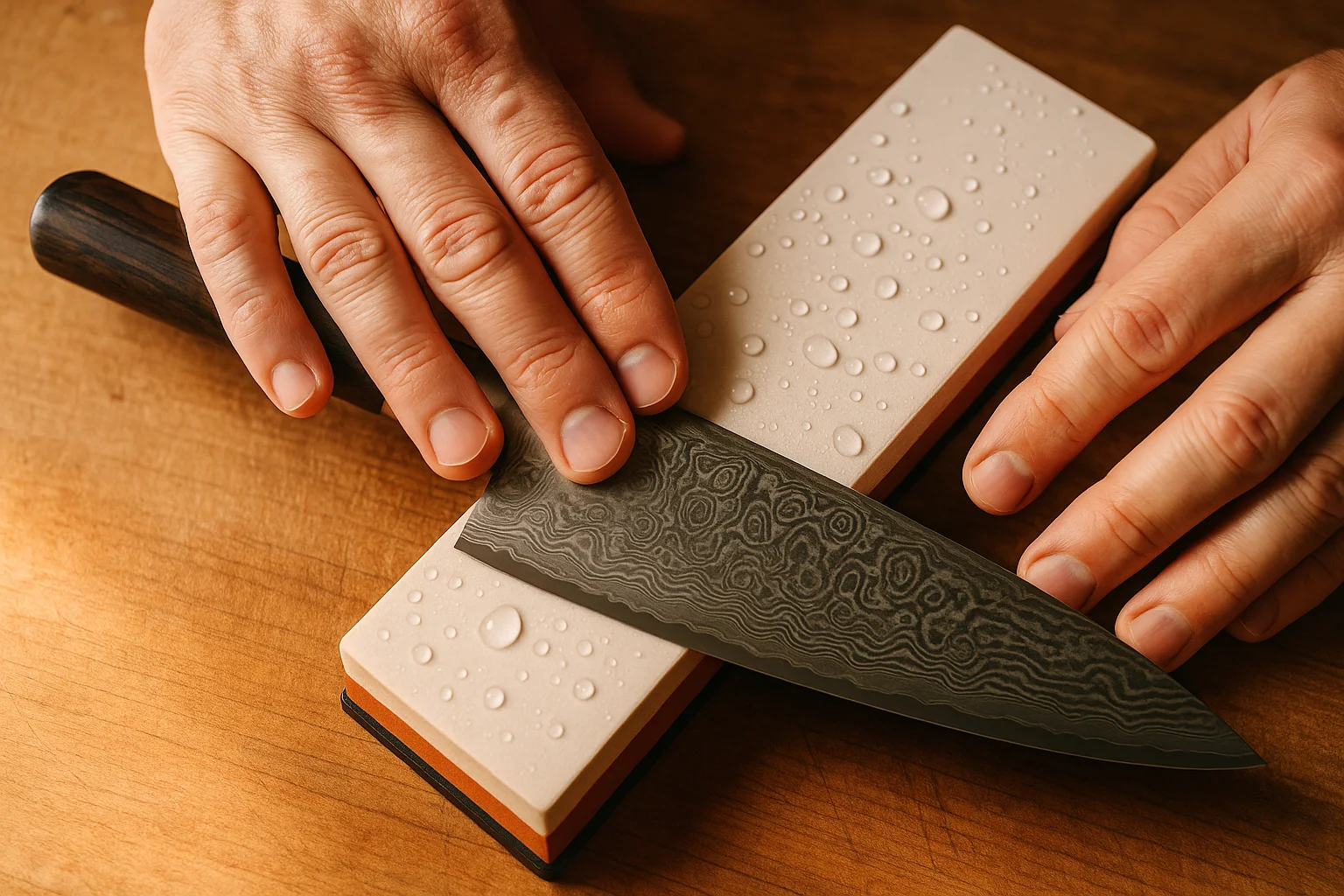
A sharp knife is safer than a dull one. That sounds backwards until you've actually used both: a dull blade needs extra force to bite into food, and extra force is exactly what makes a knife skate sideways off a tomato or a chicken bone and into your finger. A sharp edge, by contrast, needs almost no pressure — you guide it, you don't push it. Learning to sharpen a knife properly is one of the few kitchen skills that pays for itself almost immediately, in fewer near-misses and in food that's actually easier to prep.
This guide covers the core method that works for almost any knife — kitchen, pocket, or hunting — using a sharpening stone, plus the faster alternatives if you don't want to invest the time in freehand technique.
What "Sharp" Actually Means
A blade's edge is a wedge. Sharpening is the process of grinding that wedge down to a fine, consistent line where both sides meet — ideally so fine that it can no longer reflect light in a single unbroken strip. A knife that "looks sharp" but still catches the light in patches along the edge has flat, rounded-over spots that haven't met yet. Those spots are why a blade slides off a tomato skin instead of biting in.
Sharpening removes metal to rebuild that wedge from scratch. Honing, which people often confuse with sharpening, doesn't remove metal at all — it just straightens a blade edge that has rolled slightly out of alignment from normal use. You hone between sharpenings; you sharpen when honing stops bringing the edge back.
How to Sharpen a Knife on a Whetstone
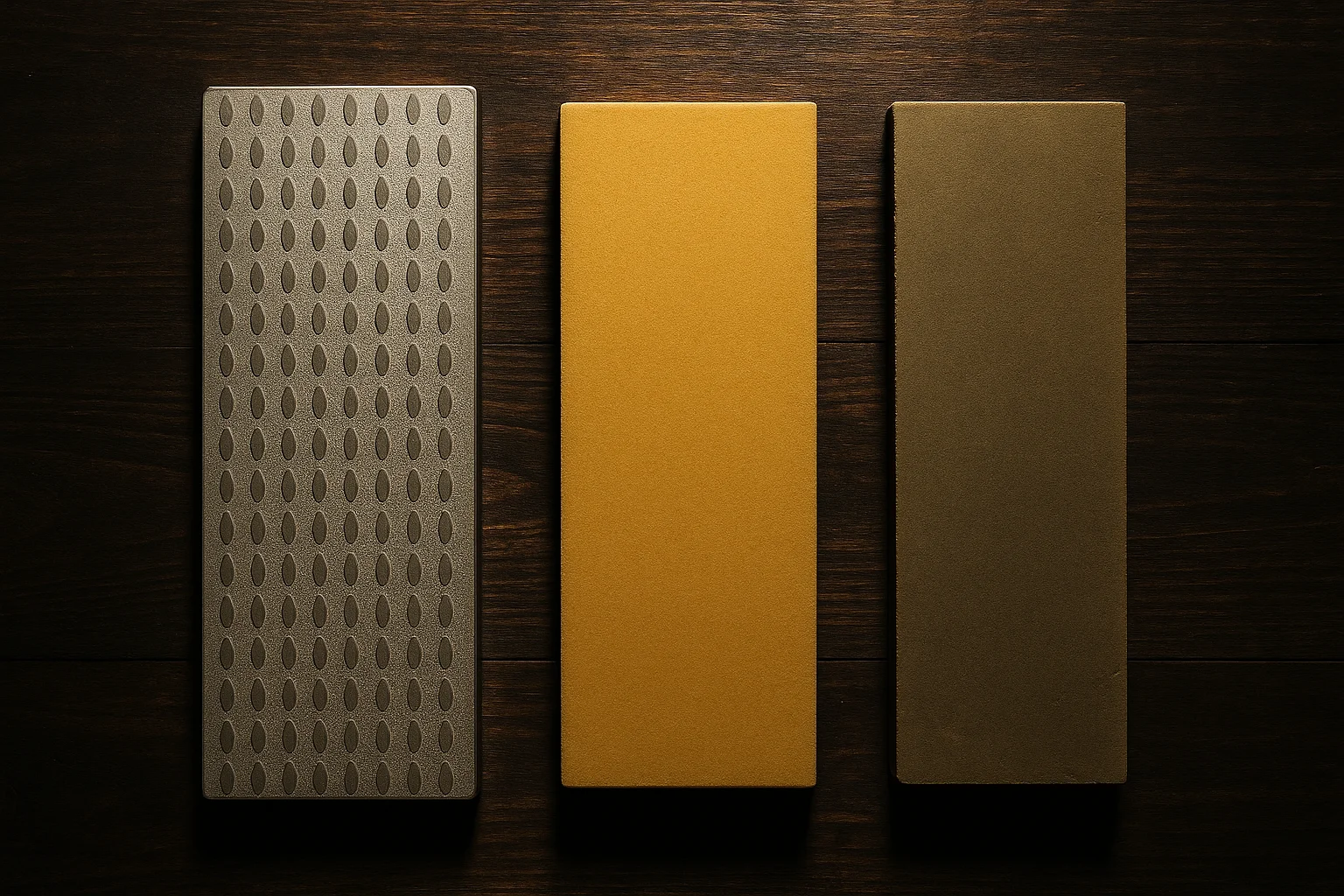
A whetstone gives more control than any pull-through gadget because you set the angle yourself and can feel the burr form as you work. It's also the method every other sharpening tool is trying to approximate, so it's worth learning even if you end up using a guided system day-to-day.
1. Soak or Wet the Stone
Water stones need to soak for 10–15 minutes until bubbles stop rising; some combination stones only need a splash. Check the stone's instructions — sharpening on a dry water stone will glaze the surface and it will stop cutting properly.
2. Pick Your Angle
Most Western kitchen knives sharpen well at 17–20 degrees per side; Japanese-style blades are often thinner and suit 12–15 degrees. A simple trick for holding the angle consistently: rest the spine of the blade on two stacked coins (roughly the right height for a 15–17 degree angle) to train your hand, then remove them once the motion feels natural.
3. Work the Coarse Grit First
Starting around 400–1000 grit, draw the blade across the stone edge-leading, heel to tip, keeping the angle constant. Use light, even pressure and alternate sides every 8–10 strokes so you don't remove more metal from one side than the other. You'll know this stage is working when you can feel a burr — a thin curl of displaced metal — form along the opposite edge. Run a fingernail lightly across the edge (never along it) to check.
4. Refine with a Finer Grit
Move to a 3000–6000 grit stone and repeat the same strokes with lighter pressure. This stage removes the coarse scratches left by the first stone and shrinks the burr down until it barely exists.
5. Remove the Burr
Finish with very light, alternating strokes, easing off pressure each pass, until the burr detaches and the edge feels clean on both sides. A few passes on a leather strop at this point will polish the edge further and align any last microscopic waviness.
6. Test the Edge
Slice into a piece of paper held in the air, or shave a few arm hairs. A properly sharpened blade should cut paper cleanly without tearing and pop hair with almost no pressure.
Faster Alternatives
Freehand stone work takes practice, and not everyone wants to spend a Saturday learning it. A few faster options:
- Pull-through sharpeners use fixed carbide or ceramic slots to set the angle for you — fast, but they remove more metal than necessary over time and can't be adjusted per knife.
- Electric sharpeners use motorized abrasive wheels at a set angle; good for speed and consistency on straight-edge blades, though most aren't gentle enough for delicate Japanese edges or Damascus patterns.
- Guided rod systems clamp the blade and hold the stone at a fixed angle via a rod, giving near-freehand quality without the freehand learning curve.
Mistakes That Ruin an Edge
The most common mistake is inconsistent angle — drifting even five degrees higher or lower mid-stroke rounds the edge instead of sharpening it. The second is rushing the burr stage: if you move to a finer grit before a burr has formed, you're only polishing a dull edge, not sharpening it. And with hand-forged Damascus blades specifically, pressing too hard on a coarse stone can wear down the pattern unevenly on one side faster than the other — light, even strokes matter more on a patterned blade than on a plain one.
How Often to Sharpen
A kitchen knife used daily typically needs a real sharpening every few months, with honing on a rod between uses to keep the edge aligned in the meantime. A pocket knife used for rougher tasks — cardboard, rope, yard work — will dull faster and may need attention every few weeks depending on use. The blade will tell you: if honing stops restoring the edge, it's time for the stone.
Comments (0)
No comments yet. Be the first to share your thoughts!
Leave a comment
Your comment will appear after it's reviewed. Your email is never shown publicly.