

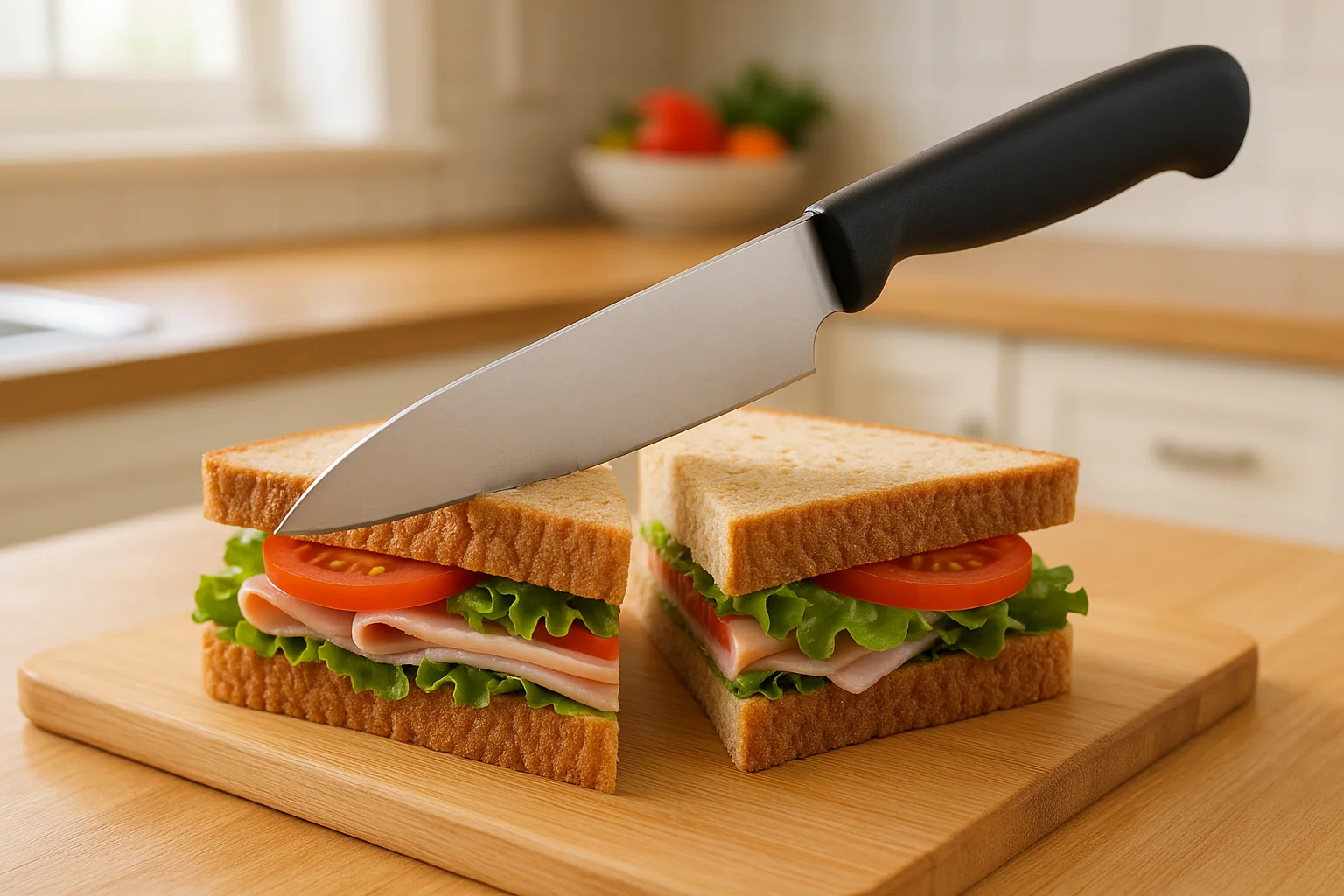
Not quite a paring knife, not quite a chef's knife — a kitchen utility knife occupies the space in between, and it's worth clarifying upfront that this refers to the kitchen knife type, not the retractable box-cutter also commonly called a "utility knife" in a hardware context.
Where It Fits in the Kitchen
At roughly 4 to 7 inches, a utility knife is longer than a paring knife but shorter and narrower than a chef's knife, handling mid-scale tasks that don't quite need the full length and heft of a chef's knife but are a bit too large to comfortably manage in-hand with a paring knife.
Everyday Uses
- Slicing sandwiches and small loaves: long enough for a clean single-stroke slice without the bulk of a chef's knife.
- Cutting small to medium fruit and vegetables: apples, tomatoes, small squash — items too large to easily hold and peel with a paring knife but not requiring board space for extensive chopping.
- Trimming cheese and cold cuts: a narrower blade than a chef's knife often gives cleaner slices on softer cheeses and deli meats.
- General light prep: any task that's a step up in scale from paring-knife work but doesn't need the rocking-chop motion a chef's knife is built for.
Serrated vs. Straight-Edge Utility Knives
Utility knives come in both serrated and straight-edge versions. A serrated utility knife saws through foods with a tougher exterior and softer interior — small crusty rolls, tomatoes — without crushing them, similar in principle to a bread knife but at a smaller scale. A straight-edge version gives cleaner, more precise slices on softer foods without the slightly ragged edge a serrated blade can leave.
Utility Knife vs. Paring Knife vs. Chef's Knife
- Paring knife (3–4"): small, in-hand precision tasks.
- Utility knife (4–7"): mid-scale tasks needing more length than a paring knife but not a full chef's knife.
- Chef's knife (7–10"): the primary workhorse for chopping, slicing, and dicing most ingredients on a board.
A three-knife set built around these three sizes covers the overwhelming majority of home cooking tasks without needing a large specialized collection.
Choosing a Utility Knife
Look for a blade around 5–6 inches as a versatile middle ground, full tang construction for balance, and — if you're deciding between serrated and straight-edge — consider whether your typical use leans more toward bread-adjacent foods (serrated) or produce and cheese (straight-edge). Some cooks keep one of each rather than choosing a single utility knife for every task.
Comments (0)
No comments yet. Be the first to share your thoughts!
Leave a comment
Your comment will appear after it's reviewed. Your email is never shown publicly.