

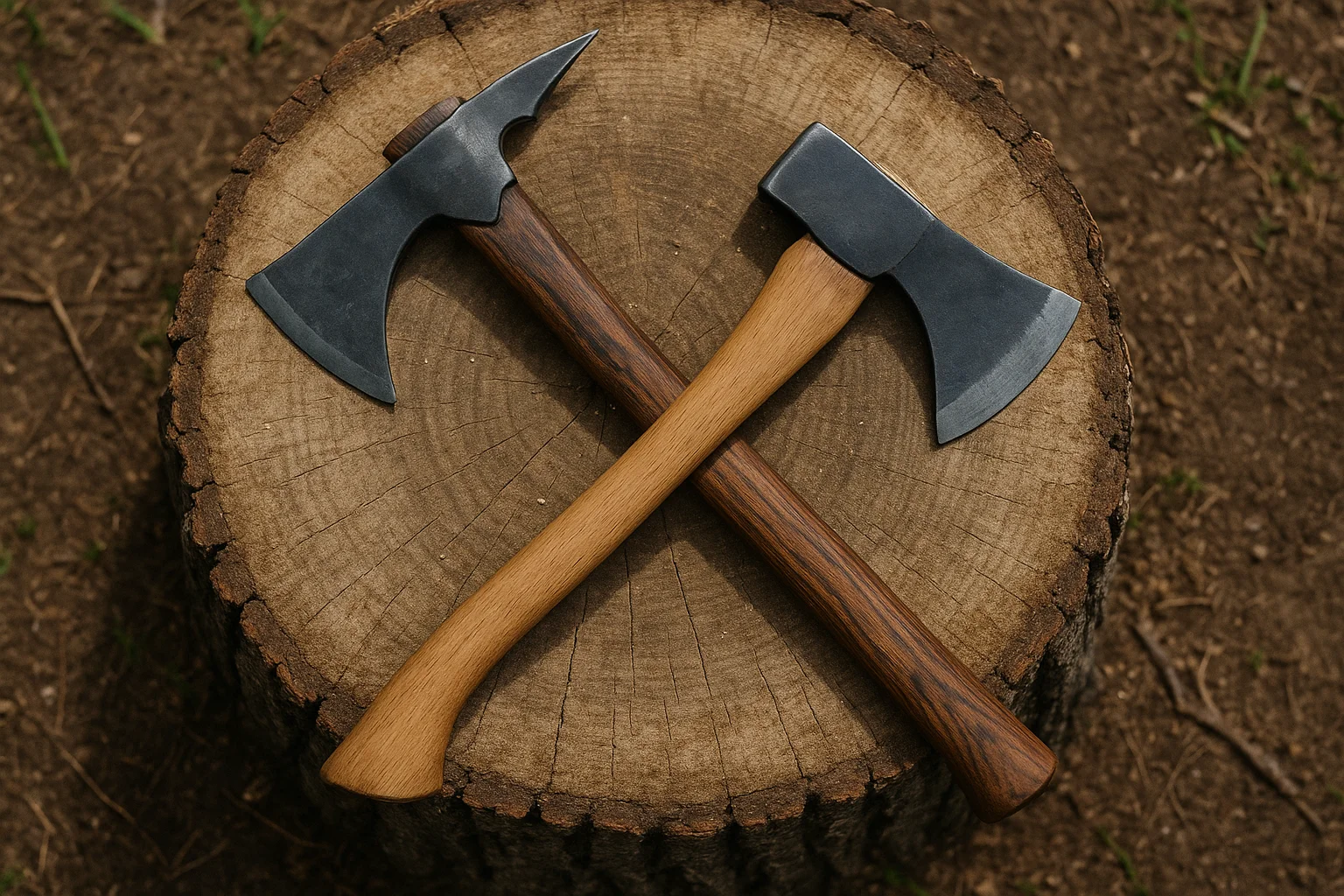
A tomahawk and a hatchet can look similar enough at a glance to seem interchangeable, but they come from different design traditions with different priorities — one favors speed and reach, the other favors splitting power — and that difference matters once you're actually choosing between them for a specific use.
Design Origins
The tomahawk traces its design back to Native American tool and weapon traditions, originally built with a lightweight head and a relatively straight handle optimized for both utility use and throwing. A hatchet's wedge-shaped head design descends more directly from general European camp and woodworking axe traditions, prioritizing splitting and chopping efficiency over throwing performance.
Head Shape and Weight Distribution
- Tomahawk: a thinner, often flatter head with less wedge-shaped mass, distributing weight for a fast, controlled swing and balanced flight when thrown.
- Hatchet: a thicker, wedge-shaped head that concentrates mass to drive apart wood fibers efficiently — better at splitting, less optimized for throwing accuracy.
Handle Differences
A tomahawk typically uses a straighter handle, which suits both a fast utility swing and a consistent throwing release. A hatchet's handle often has a slight curve, improving grip and leverage for chopping and splitting motions specifically.
Modern Uses
- Tomahawk: popular for recreational and competitive throwing (a genuinely growing sport), tactical and utility applications, and general camp use where its lighter, faster-swinging profile is an advantage.
- Hatchet: the better choice for actual wood-processing tasks — splitting kindling, general camp chopping — where its wedge-shaped head does real cutting and splitting work more efficiently.
Throwing: Where Tomahawks Clearly Win
If throwing accuracy and consistent rotation are a priority — whether for the sport of axe/hatchet throwing or general recreational use — a tomahawk's balanced, thinner head and straight handle are specifically suited to that motion in a way a hatchet's wedge-shaped, splitting-optimized head generally isn't.
Wood Processing: Where Hatchets Clearly Win
For actually splitting and chopping wood, a hatchet's wedge-shaped head does the job more efficiently, driving apart wood fibers with each strike in a way a thinner tomahawk head isn't optimized to do.
Which Should You Choose?
- Primary use is throwing (sport or recreational): tomahawk.
- Primary use is camp wood processing: hatchet.
- Want one general-purpose outdoor tool: a hatchet's splitting and chopping capability generally serves broader practical outdoor use better, though a tomahawk still handles light utility tasks reasonably well.
Comments (0)
No comments yet. Be the first to share your thoughts!
Leave a comment
Your comment will appear after it's reviewed. Your email is never shown publicly.