

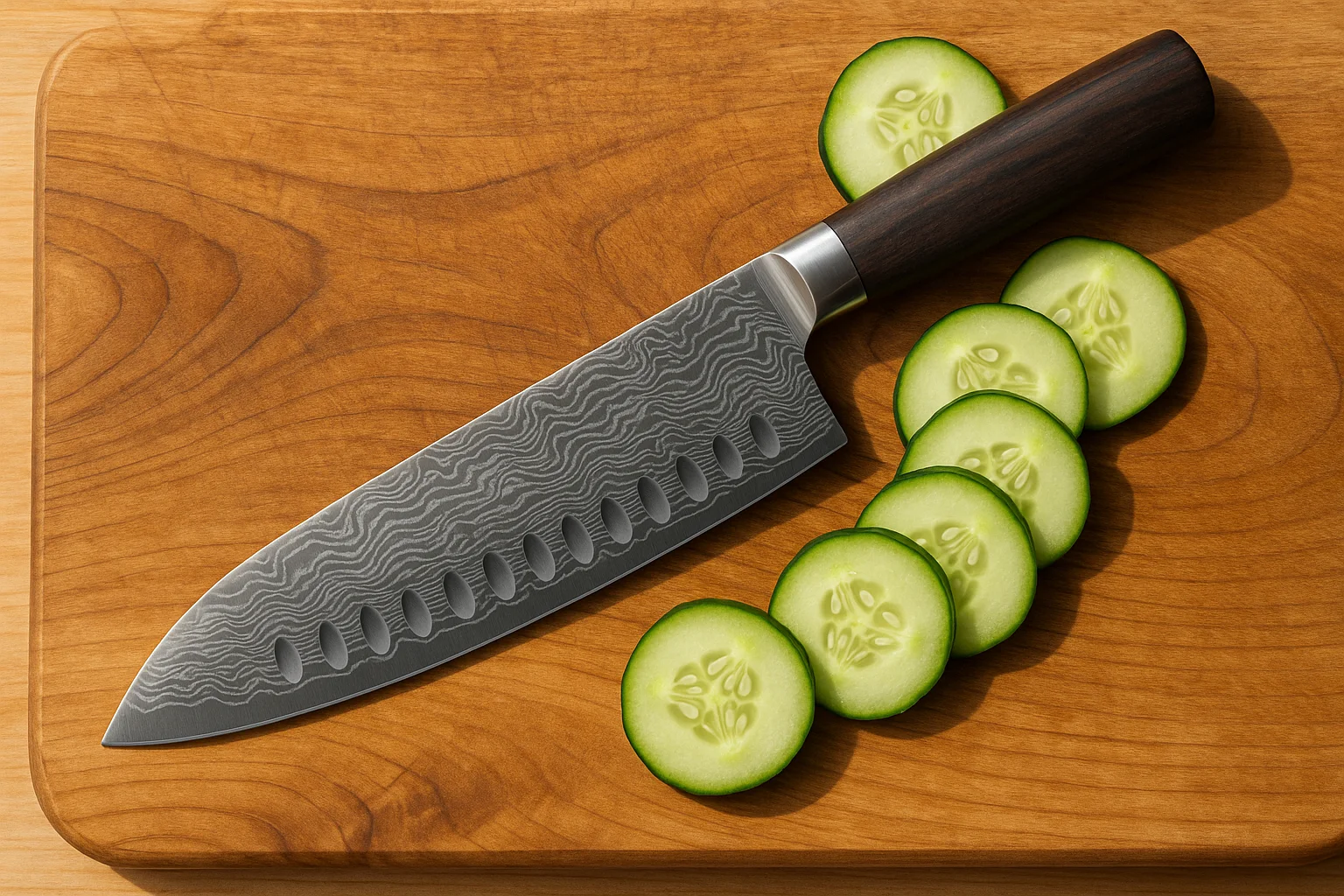
"Santoku" translates roughly to "three virtues" or "three uses," a name that points directly at what makes this knife distinct: it was designed as a single blade that handles meat, fish, and vegetables capably, without needing to specialize heavily in any one of them.
What Defines a Santoku
A santoku has a shorter, wider blade than a typical chef's knife — usually 5 to 7 inches — with a distinctly flatter edge profile and a rounded (often sheepsfoot-style) tip rather than a pronounced point. Many santoku also feature Granton edges, the small oval indentations along the blade sides that help reduce food sticking to the blade during slicing.
What a Santoku Is Used For
- Vegetable prep: the flat edge is ideal for a straight push-cutting motion, producing clean, uniform slices straight down through the board.
- Fish: the shorter, precise blade handles fillet and portion work well for many home-cooking fish tasks.
- Boneless meat: general slicing and dicing of boneless cuts, though it's not built for bone work.
- General everyday chopping: a genuinely versatile everyday knife for the bulk of typical home cooking tasks.
Santoku vs. Chef's Knife
The core difference is edge geometry and cutting motion: a santoku's flatter edge suits a push-cutting style — straight down through the food — while a chef's knife's more curved edge suits a rocking motion that pivots the blade tip along the board. Neither motion is objectively better; it comes down to which style feels more natural to you, and some cooks own both for different tasks.
Why Santoku Are Popular for Home Cooks
The shorter length and lighter weight make a santoku feel less intimidating and easier to maneuver than a longer chef's knife for cooks newer to Japanese-style blades, while still offering genuine versatility across most everyday kitchen tasks — a big part of why it's often recommended as an accessible entry point into Japanese kitchen knives.
Granton Edge: What It Actually Does
The scalloped indentations along a Granton blade create small air pockets between the blade and food as you cut, reducing suction and helping thin slices — potatoes, cucumbers — release cleanly rather than sticking to the blade face.
Choosing a Santoku
- Length: 5–7 inches, with 6.5–7 inches offering the most versatility for larger tasks.
- Granton edge or plain: Granton helps with sticky, thin-sliced foods; a plain edge is simpler to maintain and sharpen.
- Weight and balance: santoku are generally lighter than chef's knives, which suits cooks who prefer a nimbler feel.
Comments (0)
No comments yet. Be the first to share your thoughts!
Leave a comment
Your comment will appear after it's reviewed. Your email is never shown publicly.