

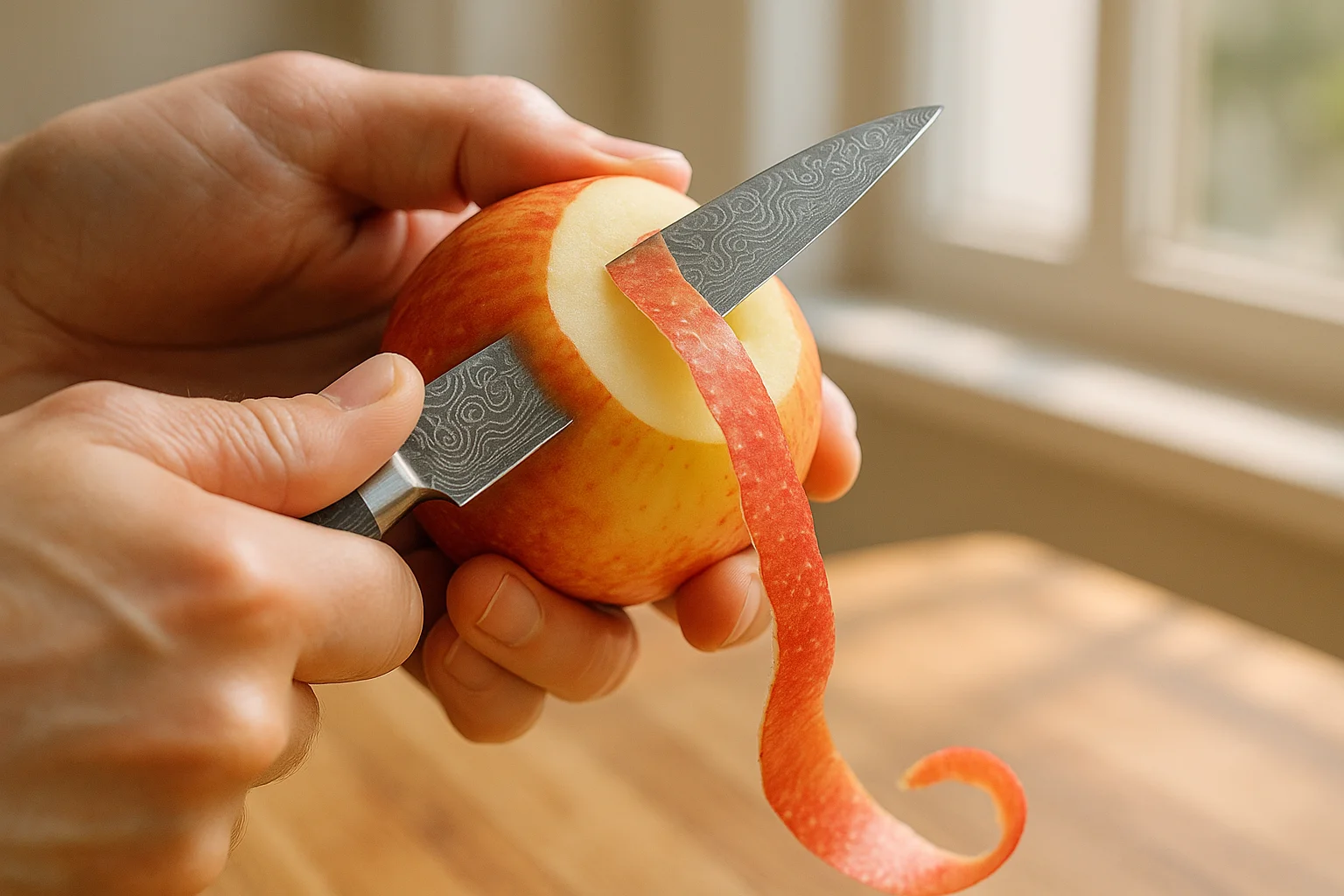
A paring knife is the smallest blade most kitchens own, and it's easy to underestimate — but for anything too small or fiddly to comfortably handle with a chef's knife, it's often the tool you actually reach for more than any other blade in the block.
What Makes a Paring Knife Different
With a blade typically between 3 and 4 inches, a paring knife trades the reach and chopping power of a chef's knife for control. Because the blade is short and light, you can hold food directly in your hand and guide the knife with precise, small movements — something that's awkward and less safe to attempt with a longer blade.
Core Everyday Uses
- Peeling: apples, potatoes, and other produce, especially when a dedicated peeler isn't handy or a more precise peel is needed around irregular shapes.
- Trimming: removing small blemishes, stems, or imperfections from fruits and vegetables.
- Deveining shrimp: the short, controllable tip makes the shallow cut needed to remove the vein cleanly.
- Hulling strawberries: the tip's precision removes the core without wasting much fruit.
- Segmenting citrus: cutting between membranes for clean supremes.
- Mincing small quantities of garlic or shallot: when only a clove or two is needed, a paring knife is often faster than pulling out a full-sized chef's knife.
- Small, precise cuts in general: deveining, scoring, garnishing, and any task where the food is held in-hand rather than on a board.
Standard vs. Bird's-Beak Paring Knives
A standard paring knife has a straight or slightly curved edge suited to general peeling and trimming. A bird's-beak (or tourné) paring knife curves downward toward the tip, which is specifically useful for peeling round fruits and vegetables and for the classic French tourné cut, where a curved blade follows a food's natural curvature more easily than a straight edge.
Paring Knife vs. Utility Knife
A utility knife is longer — typically 4 to 7 inches — and bridges the size gap between a paring knife and a chef's knife, handling mid-sized tasks like slicing a sandwich or a small piece of fruit that's slightly too large to comfortably manage in-hand with a paring knife. If a task is small enough to hold entirely in one hand while you cut, reach for the paring knife; if it needs the stability of a cutting board but doesn't require a full chef's knife, the utility knife is the better fit.
What to Look For When Choosing One
- Blade length: 3–4 inches balances control with enough cutting length for most tasks.
- Full tang or a well-secured handle: even a small knife benefits from solid construction, since precision tasks reward a knife that feels balanced and stable in hand.
- A comfortable, secure grip: because paring knife tasks are often done holding food in the other hand, handle comfort and grip security matter more than they might on a larger knife used entirely on a board.
Caring for a Paring Knife
Because the blade is short and the edge sees fine, precise work, a paring knife benefits from the same sharpening angle guidelines as other kitchen knives (roughly 15–20 degrees per side depending on style) and regular honing to keep the tip especially — which takes the most abuse in peeling and trimming tasks — performing well.
Comments (0)
No comments yet. Be the first to share your thoughts!
Leave a comment
Your comment will appear after it's reviewed. Your email is never shown publicly.