

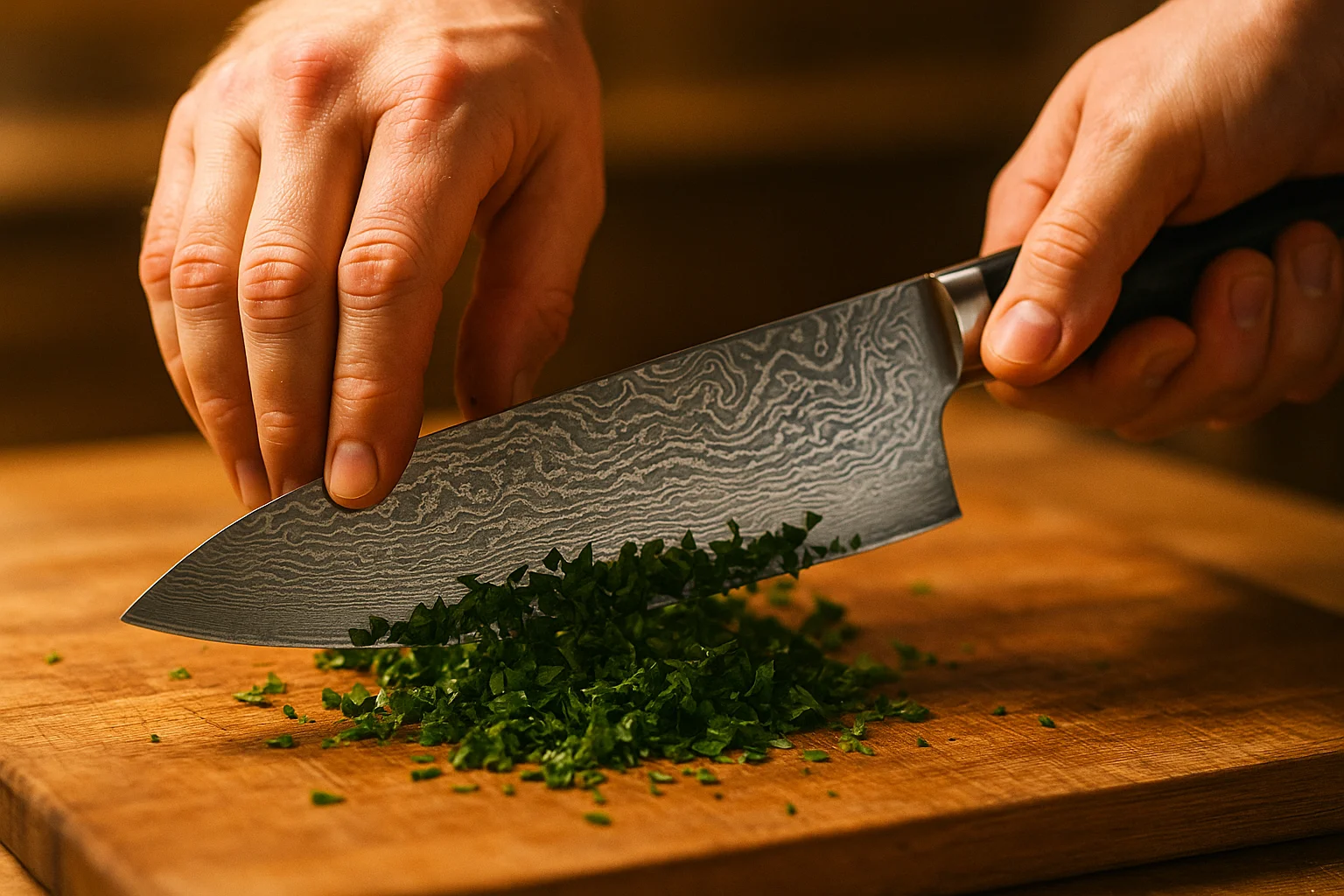
If you owned exactly one knife, it would almost certainly need to be a chef's knife — the single most versatile blade in any kitchen, handling the overwhelming majority of everyday prep from a single, consistent tool.
What Defines a Chef's Knife
Typically 7 to 10 inches, a chef's knife has a broad, curved blade that tapers to a point, with enough curve along the edge to support a rocking motion — pivoting the tip against the board while the heel lifts and falls — that's the core technique behind most chef's-knife cutting.
What a Chef's Knife Is Used For
- Chopping: vegetables, herbs, and general ingredients, using the rocking motion for efficient, continuous cutting.
- Slicing: proteins, larger vegetables, and anything needing clean, even slices.
- Dicing and mincing: the broad blade and pointed tip combine for fine, controlled cuts once you've mastered the basic grip and motion.
- The flat side for crushing: garlic cloves and similar tasks, using the same broad-blade principle as a cleaver on a smaller scale.
- Transferring ingredients: the wide blade scoops and transfers chopped food from board to pan.
The Rocking Motion
Mastering the chef's knife starts with the rocking cut: keeping the tip in light contact with the board while lifting and lowering the heel, letting the curved edge roll through the food in a continuous motion rather than lifting the whole blade off the board between each cut. This is faster and safer than a series of separate chopping strokes once the motion becomes natural.
Comments (0)
No comments yet. Be the first to share your thoughts!
Leave a comment
Your comment will appear after it's reviewed. Your email is never shown publicly.