

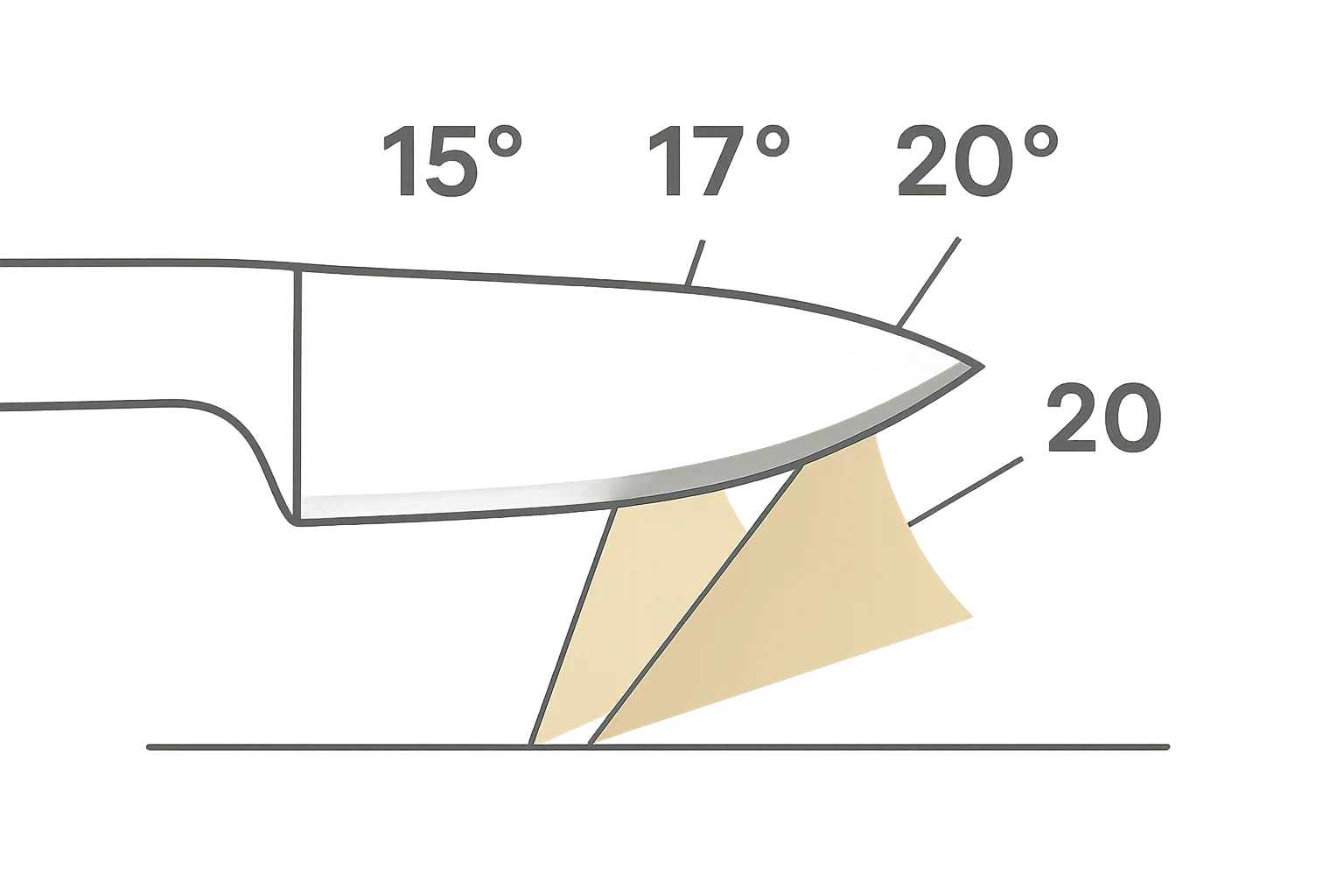
The single biggest factor in how a knife performs — sharper but more delicate, or slightly less keen but tougher — comes down to the angle its edge is ground at. Too shallow and the edge slices beautifully but chips or rolls under hard use. Too steep and it holds up to abuse but never gets quite as sharp. Getting the angle right for the knife's actual job is more important than the grit of the stone or the steel it's made from.
Why Angle Matters
A knife edge is a wedge, and the angle of that wedge is a direct trade-off between sharpness and durability. A finer angle — a thinner wedge — slices with less resistance but has a delicate apex that's easier to roll or chip against hard surfaces or bone. A steeper angle is a thicker, stronger wedge that resists damage better but requires more force to cut, since it's pushing more material aside as it goes.
Angle Guide by Knife Type
- Japanese-style kitchen knives (santoku, gyuto, nakiri): 12–15 degrees per side. Thin, precise edges suited to controlled prep work, not hard impacts.
- Western kitchen knives (chef's, paring, utility): 17–20 degrees per side. A balance of sharpness and durability for daily cooking tasks.
- Pocket and EDC knives: 20 degrees per side. Holds up to the wider, sometimes abrasive range of materials a folder cuts day to day.
- Hunting and fixed-blade outdoor knives: 20–25 degrees per side. Durability matters more than outright sharpness for field dressing and general outdoor use.
- Machetes, cleavers, and choppers: 25–30 degrees per side. Heavy impact resistance is the priority over a fine edge.
Finding and Holding the Angle Freehand
Most people overestimate how steep 15–20 degrees actually looks — it's a shallower angle than it feels natural to hold at first. A simple trick: lay the blade flat on the stone, then lift the spine until there's roughly a small coin's width of gap between the spine and the stone — that's a rough approximation of 15–17 degrees for most kitchen knife widths. Some sharpeners use two stacked coins under the spine as a physical guide while training the motion, then remove them once the angle feels automatic.
Matching an Existing Edge
If a knife already has a good factory or shop-sharpened edge, the fastest way to maintain it is simply matching the existing bevel angle rather than picking a new one. Look at the blade edge-on under good light — the visible bevel gives you a rough angle to match, and sharpening at a slightly different angle than the existing bevel means spending extra time removing metal just to reset the geometry.
Double Bevel vs. Single Bevel
Most Western and general-purpose knives are sharpened symmetrically — the same angle on both sides. Traditional single-bevel Japanese knives (many yanagiba and usuba styles) are ground almost entirely on one side, which needs a different, more specialized sharpening approach and isn't something to attempt with a standard double-bevel technique.
When to Change a Knife's Angle
It's possible to reprofile a blade to a new angle — say, taking a 20-degree hunting knife down to 17 degrees for finer cutting — but it takes significant time on a coarse stone to grind the whole bevel back. It's usually only worth doing if the knife's actual use has genuinely changed, not as a routine adjustment.
Comments (0)
No comments yet. Be the first to share your thoughts!
Leave a comment
Your comment will appear after it's reviewed. Your email is never shown publicly.