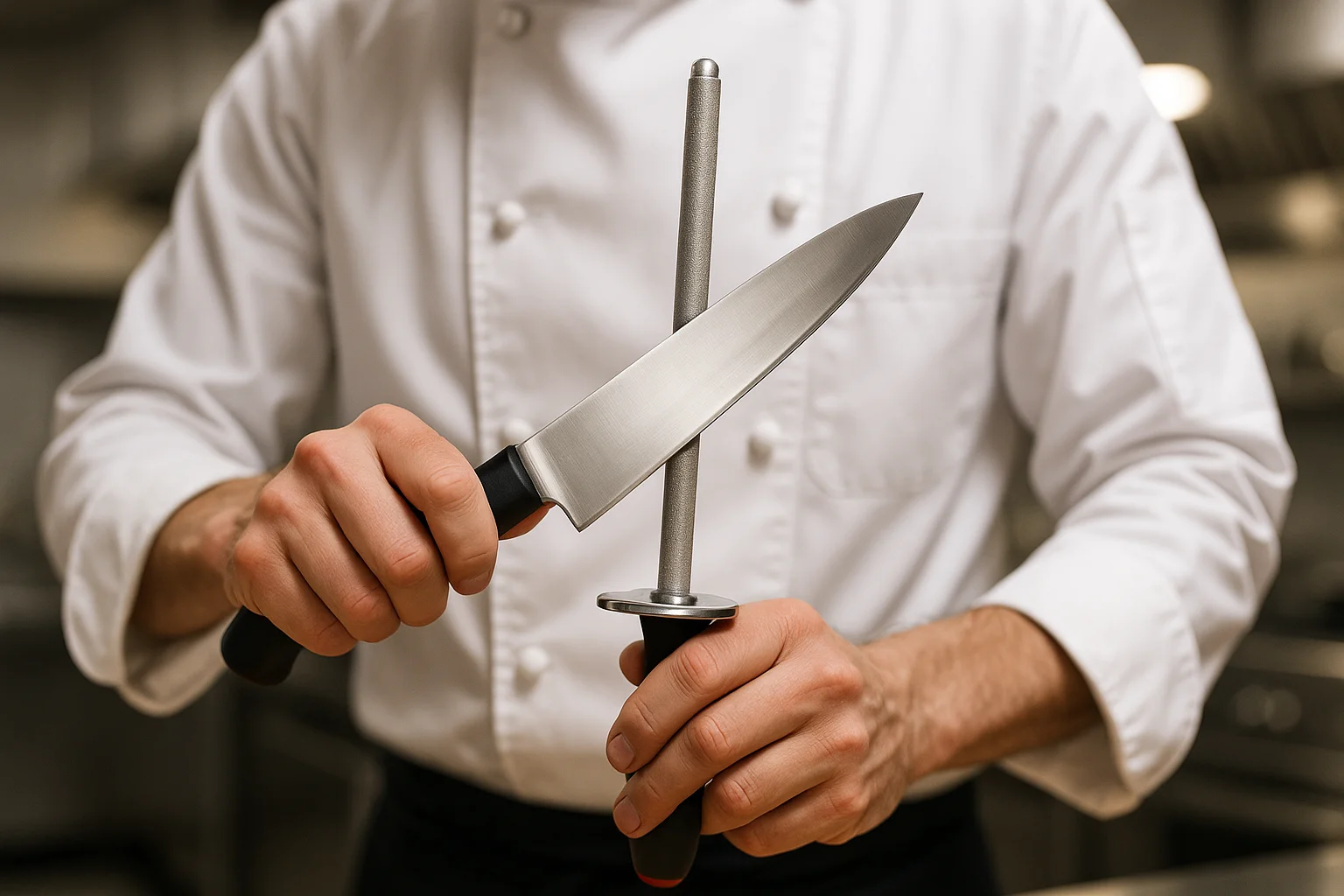
Learn the correct technique for sharpening — not just honing — a knife using a sharpening rod.
Most people only ever use a sharpening rod to hone — a few quick strokes to realign an edge before dinner. But a genuinely abrasive rod, usually diamond-coated rather than smooth steel, can actually sharpen a blade, removing metal the same way a stone does. It's a different tool doing a different job than the honing steel most kitchens already have, even though they look almost identical.
Honing Rod vs. Sharpening Rod
A smooth or finely-ridged steel rod only realigns a rolled edge — it doesn't remove meaningful metal. A diamond-coated or ceramic rod is genuinely abrasive and can grind a new edge the same way a stone does, just in a different form factor. Check the rod: if it's described as diamond, ceramic, or has a visibly gritty texture rather than smooth steel, it's built for real sharpening, not just honing.
Setting Up
Hold the rod vertically, tip resting firmly on a towel or cutting board to keep it from slipping, or use a rod with a built-in handle guard. Choose your target angle — 15–20 degrees per side depending on the knife type — and keep it consistent through the whole stroke.
The Sharpening Stroke
1. Position the Blade
Starting at the heel, place the blade against the rod at your chosen angle, with the edge facing down toward the rod's base.
2. Draw Down and Across
In one smooth motion, draw the blade down the length of the rod while also moving it across so the entire edge — heel to tip — passes over the abrasive surface, not just one spot.
3. Alternate Sides
Switch to the opposite side after each stroke, keeping the angle and pressure as consistent as possible between sides. Uneven strokes between sides will leave one side of the edge sharper than the other.
4. Check for a Burr
Every 8–10 strokes, feel along the opposite edge (not along the blade) for a thin burr — the sign that you're actually removing metal and building a fresh edge rather than just polishing the existing one.
5. Finish Light
Once a burr has formed evenly along the whole edge, finish with several very light alternating strokes to remove it, then test the edge on paper or against a fingernail.
Advantages Over a Flat Stone
A rod is compact, needs no soaking or flattening, and works well for touch-ups without setting up a full stone station. Some rods also taper, which is genuinely useful for reaching into curved or serrated sections a flat stone can't access.
Limitations
A rod's round profile makes it harder to feel and correct your angle compared to a flat stone, and most rods are limited to a single grit, so you can't progress through coarse-to-fine stages the way a stone set allows. For a knife that's badly damaged or hasn't been properly sharpened in a long time, a flat stone is usually still the better starting point.


Comments (0)
No comments yet. Be the first to share your thoughts!
Leave a comment
Your comment will appear after it's reviewed. Your email is never shown publicly.