

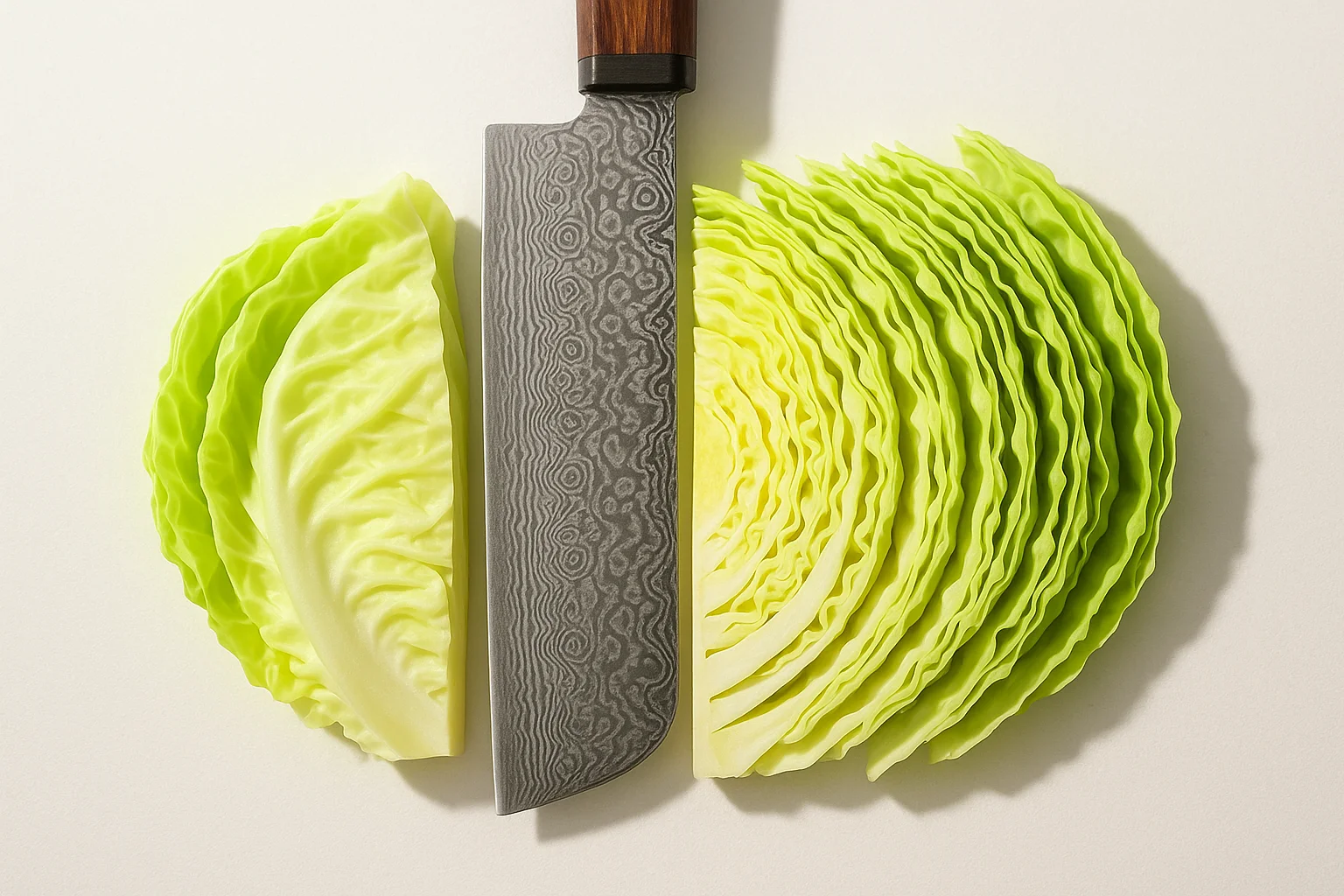
Most kitchen knives compromise on vegetable cutting to also handle meat and other tasks. The nakiri doesn't — its rectangular, flat-edged blade is built for one job specifically, and it does that job better than any general-purpose knife can.
What Defines a Nakiri
A nakiri has a distinctive rectangular blade shape with a perfectly flat edge and squared-off tip, rather than the curved edge and pointed tip of a chef's knife or santoku. This shape is purpose-built for a straight up-and-down push-cutting motion rather than any kind of rocking or slicing technique.
What a Nakiri Is Used For
- Straight push-cuts through vegetables: the core use — the flat edge contacts the board along its entire length in a single downward motion, producing clean, uniform slices.
- Julienne and fine dicing: the flat edge makes it easier to produce consistently sized matchsticks and dice than a curved-edge knife.
- Cutting through dense vegetables: cabbage, squash, and root vegetables cut cleanly with the full edge engaging at once.
- Thin, even slicing: cucumbers, radishes, and similar vegetables slice into consistently thin, even pieces.
Why the Flat Edge Matters
A curved chef's knife edge only contacts the board at one point during a straight downward cut, which is why chef's knife technique relies on a rocking motion to cut efficiently. A nakiri's flat edge contacts the board along its full length in a single push, producing a cleaner, more uniform cut through vegetables without needing to rock the blade at all.
Comments (0)
No comments yet. Be the first to share your thoughts!
Leave a comment
Your comment will appear after it's reviewed. Your email is never shown publicly.