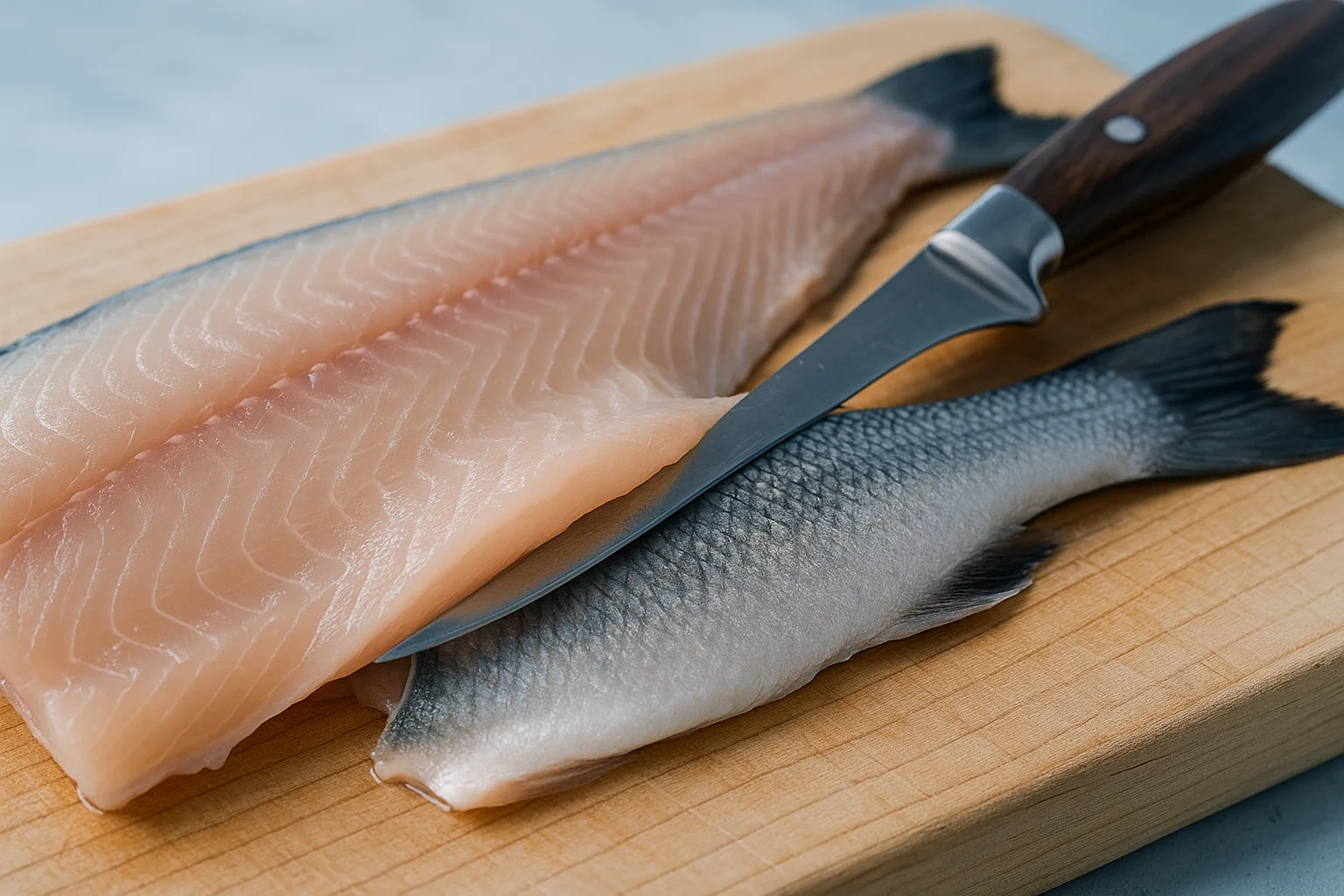
A fillet knife's thin, flexible blade is built to separate fish from bone with minimal waste.
A fillet knife's thin, flexible blade looks almost fragile next to a sturdy chef's knife — and that's exactly the point. Flexibility, not stiffness, is what lets it do its job well: separating delicate fish flesh from skin and bone with minimal waste.
Why Flexibility Matters
Fish anatomy isn't flat — the bone structure curves, and the flesh sits close against it in a way that a stiff blade can't follow without either leaving meat behind or cutting into bone. A fillet knife's thin, flexible blade bends slightly under light pressure, letting it hug the contour of the fish's bone structure as you work, which is what produces a clean fillet with very little wasted flesh.
Core Uses
- Filleting whole fish: the signature task — separating flesh from the backbone and rib cage in a smooth, continuous motion.
- Skinning fillets: the thin blade slides between flesh and skin with minimal loss on either side.
- Trimming and portioning: cleaning up a fillet, removing the thin belly section, or portioning into individual servings.
- Deboning: removing pin bones and other small bone structures from a fillet after the main separation.
Choosing the Right Flex
Fillet knives are sold across a range of flexibility, and matching that flex to the fish you're working with matters:
- Stiffer flex: better suited to larger, firmer fish where more control and less bend is useful.
- Medium flex: a versatile middle ground that handles a broad range of common fish sizes.
- Very flexible: ideal for smaller, more delicate fish where following a tighter curve against fine bone structure matters most.
Fillet Knife vs. Boning Knife
The two look similar and are sometimes used interchangeably, but a fillet knife is generally thinner and more flexible, purpose-built for fish, while a boning knife has a bit more stiffness suited to working around denser meat and poultry bone structures. A boning knife can sometimes fill in for lighter fish work, but a true fillet knife's extra flex gives noticeably better results on fish specifically.
Technique Basics
Most fillet cuts start with an angled cut behind the gills down to the backbone, then a long, smooth stroke along the backbone toward the tail, letting the blade's flex follow the bone's contour rather than forcing a straight line through it. Keeping the blade flat against the bone structure, rather than angling into the flesh, is what minimizes waste.
Caring for a Fillet Knife
Because the thin blade sees delicate, precise work, a fillet knife benefits from a fine edge — typically 15–17 degrees per side — and gentle handling, since the same flexibility that makes it effective also makes it more prone to damage from twisting or prying use it isn't built for.


Comments (0)
No comments yet. Be the first to share your thoughts!
Leave a comment
Your comment will appear after it's reviewed. Your email is never shown publicly.