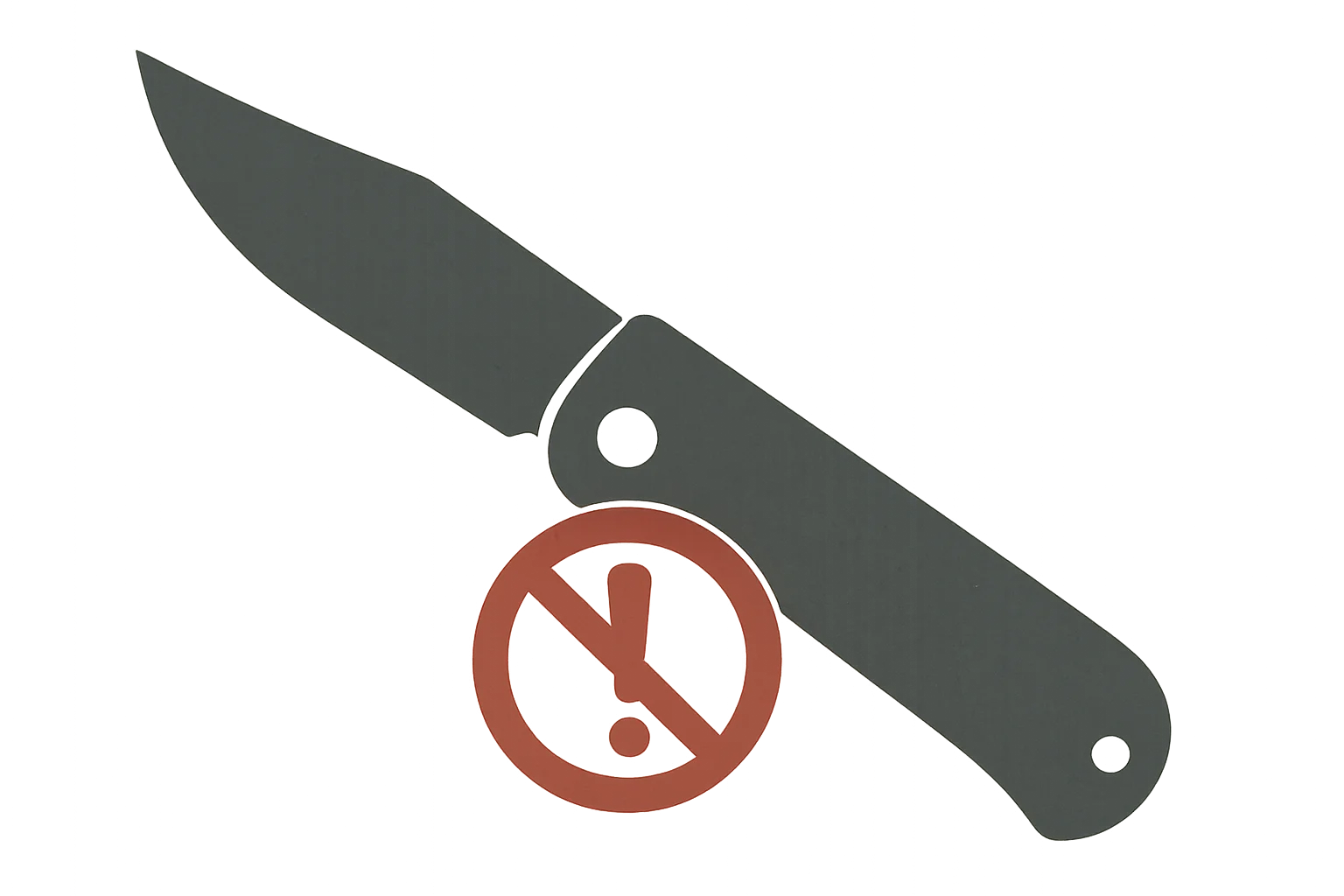
Ballistic knives fire their blade like a projectile — and they're federally banned in the US.
Most restricted knife categories are defined by blade shape, length, or opening mechanism. A ballistic knife is different — it's defined by what the handle does, not the blade, which is exactly why it sits in its own, uniquely restricted legal category in the US regardless of size.
How a Ballistic Knife Works
A ballistic knife uses a spring-loaded or, in some historical and fictional designs, gas-propelled mechanism inside the handle to physically launch the blade away from the handle as a projectile, rather than simply extending it the way a switchblade or OTF knife does. Pressing a release detaches and fires the blade forward, meant to be thrown or launched rather than remain attached to the handle during use.
Why It's Regulated Separately From Other Automatic Knives
Switchblades and OTF (out-the-front) knives are automatic in that the blade deploys via a spring, but the blade stays physically attached to the handle throughout use — it's still fundamentally a knife you hold and cut with. A ballistic knife's blade physically separates from the handle and becomes a projectile, which US federal law treats as different enough to warrant its own specific, separate ban, independent of the switchblade restrictions that apply to interstate sale of spring-assisted folders.
Legal Status in the US
Ballistic knives are federally banned in the US under a specific statute targeting this exact mechanism, regardless of blade length or the knife's stated purpose. This is one of the more clear-cut, unambiguous restrictions in US knife law compared to areas like state-by-state blade-length rules, precisely because the federal ban applies uniformly rather than varying by state.
Why This Category Rarely Comes Up in Practice
Genuine ballistic knives are uncommon in ordinary retail and collector markets specifically because of the clear federal ban, and most modern knife discussions or purchases never actually intersect with this category — it's more commonly referenced in movies, video games, and general knife-law education than encountered as an actual product.
How This Differs From Throwing Knives
A traditional throwing knife — a solid, purpose-balanced fixed blade thrown by hand — is a completely different and generally unrestricted category from a ballistic knife. The distinction is the mechanism: a throwing knife has no internal launching mechanism at all; a ballistic knife's defining feature is exactly that mechanism.
This article is general information, not legal advice. Ballistic knives are federally banned in the US — verify current federal and state law if you have any specific questions about this category.


Comments (0)
No comments yet. Be the first to share your thoughts!
Leave a comment
Your comment will appear after it's reviewed. Your email is never shown publicly.