

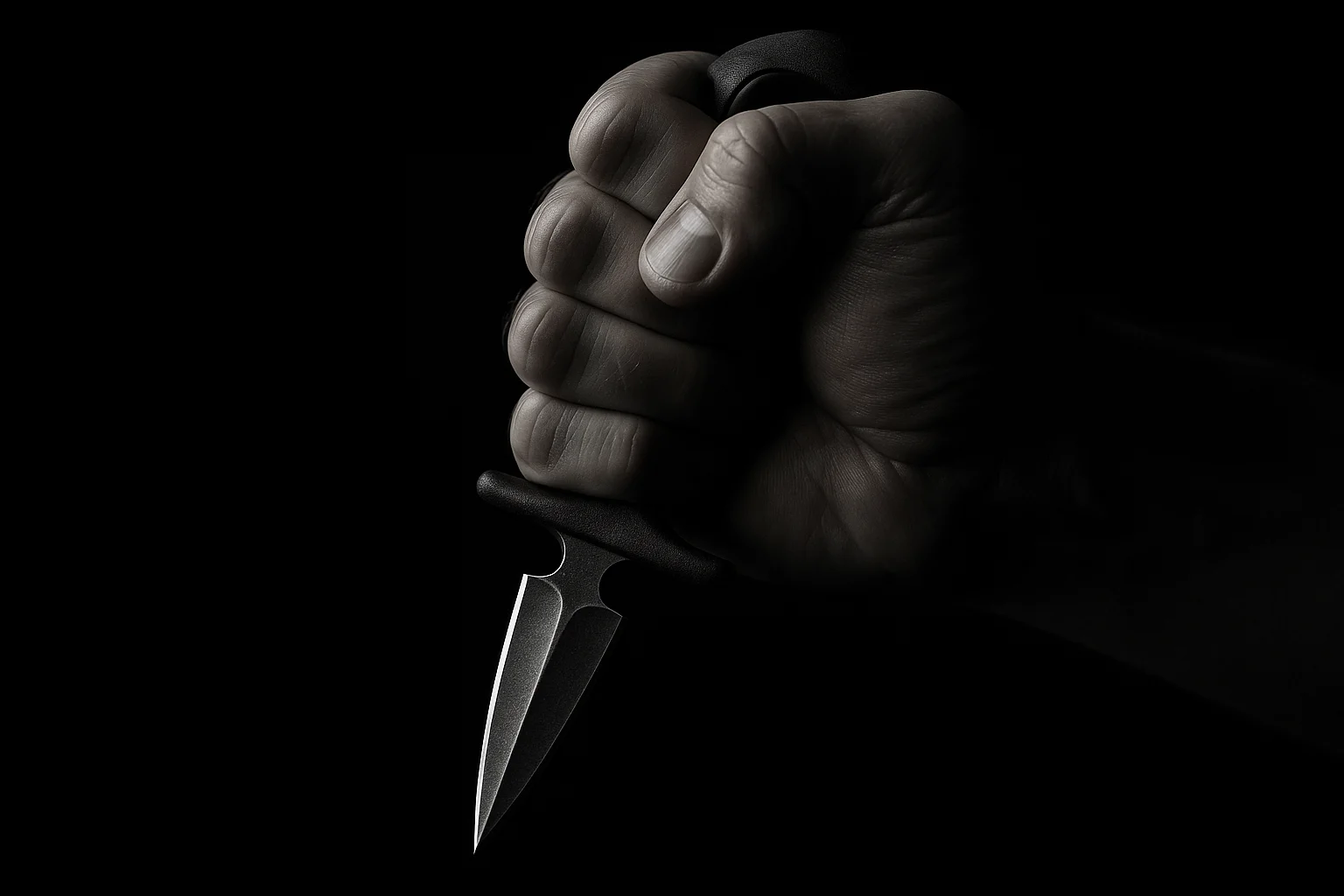
Grip a standard knife and the blade extends forward from your fist. Grip a push dagger and the blade projects from between your fingers instead — a fundamentally different design goal that shows up in both its history and its unusually specific legal treatment in several states.
The Distinctive Grip and Design
A push dagger is built around a T-shaped or perpendicular handle, sometimes incorporating a finger-hole grip, that's held in a closed fist with the blade projecting outward from between the index and middle fingers (or similar) rather than extending in line with the forearm the way a conventionally gripped knife does. This grip orientation is purpose-built for a forward thrusting motion delivered with a punching-style strike.
Historical Use
Push daggers have a documented history as concealable self-defense weapons, valued historically for how easily the T-handle design could be hidden — in a boot, a vest, or a similarly compact space — and deployed quickly compared to a conventionally sheathed and drawn knife. Design variations of the concept appear across multiple regions and eras, generally sharing the same core T-handle or perpendicular-grip principle.
Why It's Classified Separately Under Some State Laws
Several states specifically name daggers and similar thrusting-focused, double-edged blade types under "dirk and dagger" statutes that treat them differently from ordinary single-edged utility or folding knives — and a push dagger's design, oriented entirely around thrusting with essentially no general utility cutting function, often falls squarely within these dagger-specific classifications rather than the more permissive general knife-carry rules that apply to typical EDC or kitchen knives.
How This Differs From an Ordinary Fixed-Blade Knife
An ordinary single-edged fixed-blade knife, gripped conventionally and used for general cutting tasks, is generally covered under the standard knife-law framework (blade length, carry method, and so on) that applies broadly in most states. A push dagger's specialized grip and thrusting-only design purpose is exactly the kind of feature that triggers the more specific and often more restrictive dagger classification in states that have one.
Practical Guidance
- Check whether your state has a specific "dirk and dagger" statute and how it defines the category.
- Understand that a push dagger's design is more likely to fall under dagger-specific restrictions than general knife-carry rules.
- Consider that push daggers are a niche, specialized design — most everyday cutting needs are better served by an ordinary utility or EDC folder that avoids this added legal complexity.
This article is general information, not legal advice. Push dagger legality varies by state and often falls under specific "dirk and dagger" statutes — verify current local law before purchasing, owning, or carrying one.
Comments (0)
No comments yet. Be the first to share your thoughts!
Leave a comment
Your comment will appear after it's reviewed. Your email is never shown publicly.